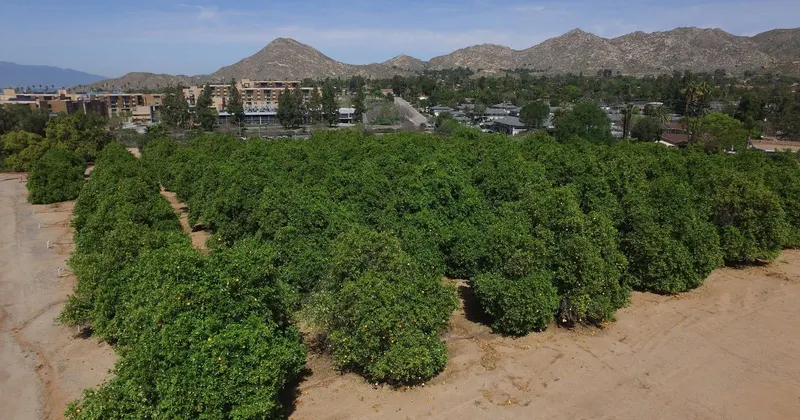
On an intensive farm there are several ways to divide up the land: the farm, the cadastral plot, the SIGPAC enclosure (Spain's official land parcel identification system), the irrigation sector, the variety. None of them fully matches the way decisions are actually taken in the field. The decision unit is exactly that: the portion of land that is managed as a whole. This article explains what it is, how to define it and why bringing your data down to that level changes the way you manage your farm.
What a decision unit is
A decision unit is the part of the farm on which decisions are taken jointly: it is pruned in the same way, treated at the same time, irrigated with the same criteria and harvested at the same moment. It usually matches what the farm calls a "plot", but not necessarily the cadastral plot or the official enclosure.
What defines it is uniform management. For a piece of land to be a single decision unit, it should share:
- The same species and variety (or a stable combination of pollinating varieties).
- A similar planting age.
- The same irrigation system or the same sector.
- A similar rootstock and planting layout.
- Soil and exposure conditions without major differences.
If within a "plot" there is an area that is always treated separately, harvested earlier or gives different problems, then in reality you have two decision units. The reverse also happens: two adjoining cadastral plots, with the same variety, planted in the same year and irrigated by the same sector, can be managed as a single unit without losing useful information.
The levels of a farm
| Level | What it is for | Limitation |
|---|---|---|
| Farm | Overall view, overhead costs, administrative management | Mixes very different varieties and situations. |
| Variety | Comparing the yield and cost of each variety | Does not distinguish between good and poor plots of the same variety. |
| Decision unit (plot) | Deciding on treatments, irrigation, field tasks, harvesting and replanting | Requires every operation to be recorded against its plot. |
| Irrigation sector | Scheduling irrigation and fertiliser application through fertigation | Does not always match the plots. |
| SIGPAC enclosure / REA | Dealing with the authorities: subsidies, digital logbook | Designed to identify the land, not to manage it. |
The practical approach is to work at decision unit level and obtain the other levels by aggregation: several units make up a variety on a farm, and several farms make up the holding. In addition, keep a clear record of how each unit corresponds to its official enclosure and its irrigation sector.
Why it changes the way you manage
Costs stop being an average
When costs are tracked by farm, every plot looks equally expensive. If they are tracked by decision unit, reality appears: the plot that needs twice as many treatments, the one that uses more water, the one that takes more pruning hours. With that information you can decide what to grub up, what to replant and where to invest.
Treatments are fine-tuned
A treatment order for each decision unit lets you treat only where it is needed, with the real dose and area. That saves product, reduces residues and leaves a consistent record for the farm logbook and for traceability.
Production can be compared
The kilos per hectare of a whole farm say little. Those of each decision unit, compared with one another and season by season, show which plots perform and which do not, and allow you to look for the cause.
Traceability is simplified
If fruit is harvested and identified by decision unit, every lot sold can be traced back to its plot and everything that was applied to it.
How to define your decision units
- Start from how you work today. Ask the foreman what he calls each section and which ones he treats or harvests separately.
- Separate what is managed differently. Different varieties, different ages, different irrigation sectors.
- Don't overdo it. If you divide too much, recording every operation becomes impossible and nobody will do it. A unit has to make operational sense.
- Give them a stable code. A short identifier that everyone uses: the foreman, the technician, the office and the delivery notes.
- Link each unit to the official data. Its SIGPAC enclosure and its REA entry (Spain's agricultural holdings register), for the digital logbook and subsidies.
- Link each unit to irrigation. Which sector or sectors irrigate it.
- Review whenever the planting changes. Grubbing up, replanting or a change of variety can split or merge units.
Common mistakes
- Using the cadastral plot as the management unit when it contains several varieties.
- Different codes in the field, in the office and in the packhouse for the same plot.
- Not recording the plot against consumption, which forces you to allocate it afterwards by area and loses the detail.
- Changing units without leaving a trace, so that seasons are no longer comparable.
The decision unit in GAP
GAP was built around this idea. It maintains and lets you consult agronomic, technical and financial information at farm, variety and decision unit (plot) level, and allows you to analyse it by plot or by hectare as well, with details of products and active substances and specific handling for irrigation sectors. You can see everything it does in its features.
On that basis, costs are produced by farm, variety or plot, broken down by product or task, and irrigation, fertiliser and treatment orders are prepared by plot and sector. Everything is analysed on the map: you tap a plot and see its variety, its area and the value of the study for that season.