
Farm data
Name, address and registration number of the farm, its holder, the staff holding an applicator's or adviser's card and the farm's own spraying equipment, with its ROMA registration (the Spanish machinery register) and last inspection.
Guide · RD 1311/2012
In Spain, Royal Decree 1311/2012 requires every farm to keep spray records in a farm logbook (cuaderno de explotación) with its plots and the plant protection treatments it applies. We explain what data it must include and what changes on 01/01/2027.
What it is
It is the record of plant protection treatments that every farm must keep up to date. It is governed by Article 16 of Real Decreto (Spanish Royal Decree) 1311/2012, which now calls it the “Cuaderno Digital de Explotación Agrícola” (digital farm register). In the field it is still called the cuaderno de campo (field logbook) or cuaderno de explotación (farm logbook).
These pesticide records show what was applied, where, when, against what and who did it. Integrated production, organic production or certified scheme logbooks also count as the record if they include at least the data required by the regulations.
What it must include
Annex III of Real Decreto 1311/2012 sets out the minimum information for agriculture:
Name, address and registration number of the farm, its holder, the staff holding an applicator's or adviser's card and the farm's own spraying equipment, with its ROMA registration (the Spanish machinery register) and last inspection.
Identification number, SIGPAC reference, area in hectares, use, species and variety for woody crops, rain-fed or irrigated, and open-field or protected. Also soil data.
Date, plot, pest to be controlled, applicator and adviser, crop and variety, area treated, product with its trade name and registration number, equipment and quantity used.
An assessment of the treatment's efficacy and other remarks. The annex also has a section for fertilisation and irrigation.
Paper or digital
Agricultural professionals can keep pesticide records on paper until 31/12/2026. From 01/01/2027 they must be kept electronically (Real Decreto 1311/2012, amended by Real Decreto 1039/2025, BOE, Spain's Official State Gazette, of 20/11/2025).
In electronic format, the data is entered in the application enabled by the competent authority within one month of each treatment. The records and their documentation (advice, equipment inspection, contracts, invoices and residue analyses) are kept for at least 3 years. What becomes mandatory in digital form is the record of plant protection treatments: the rest of the digital farm register remains voluntary for as long as the CAP 2023-2027 lasts (Real Decreto 34/2025).
Fertilisation is recorded too: since 01/01/2026, all fertilisation operations must be recorded in the logbook, on paper or digitally, with the exemptions set by Real Decreto 1051/2022 (Ministry of Agriculture note of 21/10/2025). We explain it in the fertigation guide.
With GAP
In GAP, treatments are recorded from the treatment order itself, by estate, variety and plot, with their items, pre-harvest intervals, pests and active substances. That way your spray records fill up with day-to-day work, not at the end of the season.
And treatments are sent to Spain's digital farm register (CUE) through your region's official service, as the grower or as an authorised entity.
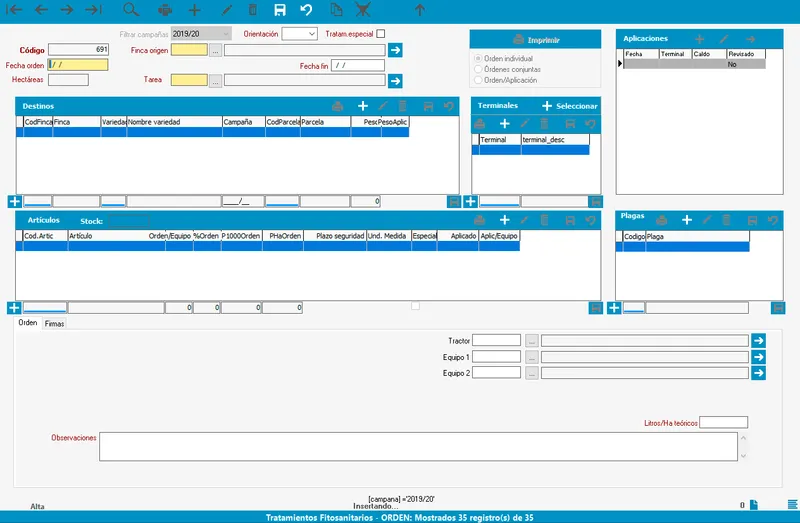
The record of plant protection treatments that every farm must keep up to date, with data on the farm, its plots and each treatment. Real Decreto 1311/2012 calls it the “Cuaderno Digital de Explotación Agrícola” (digital farm register).
Yes. Every farm must keep its record of plant protection treatments up to date (Article 16 of Real Decreto 1311/2012).
The treatment record, until 31/12/2026. From 01/01/2027 it must be electronic (Real Decreto 1039/2025).
At least 3 years, with its documentation: advice, equipment inspection certificates, contracts, invoices and residue analyses.
Yes. Since 01/01/2026, fertilisation operations must be recorded in the logbook, on paper or digitally, except for the exemptions set by the regulations.
Using the contact form or by calling +34 959 54 07 12.
GAP
GAP's treatments are sent to Spain's digital farm register (CUE) through your region's official service.
Purchasing, sales and invoicing, warehouses, costs and staff alongside field management.
A photo of the report, a voice note or a message become work days, tasks and treatments.
Costs by estate, variety or plot, by item or by task, including labour and fixed assets.
Irrigation, fertilisation and treatment orders by plot, with their products and active substances.
Yield estimates, fruit analysis, sizes, sales delivery notes, harvest log and final valuation.
Product traceability, GlobalG.A.P. and integrated production, stock and warehouses.
What fertigation is, what Real Decreto 1051/2022 requires and how fertilisation is recorded.
GAP
Request information and we will look together at how you would use it on your estates, with no obligation.