Pesticides, fertiliser and day labour show up in the invoices every month. Machinery, irrigation installations, greenhouses or the plantation itself do not: they are paid for once and used for years. That is why they are the part of the cost that is most often forgotten, and the one that distorts the result most when it is missing. This article explains how to bring fixed assets into your farm costs and allocate them across plots using a sensible criterion.
What counts as a fixed asset on a farm
From a management point of view, a fixed asset is anything you buy or build to use over several seasons. On an intensive-crop farm this usually includes:
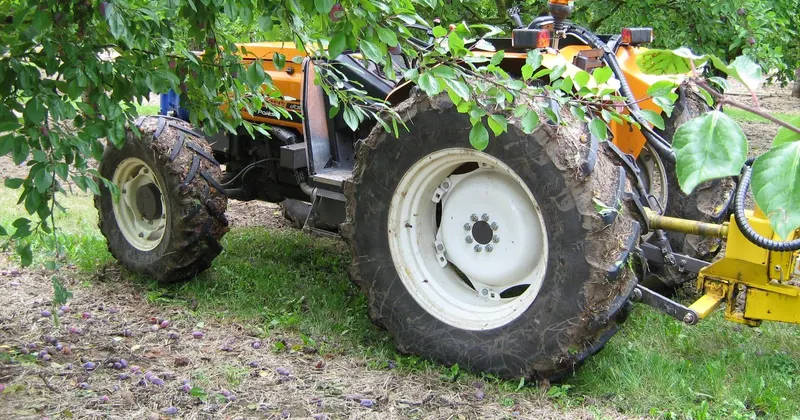
- Machinery: tractors, sprayers, brush cutters, platforms, trailers.
- Installations: irrigation heads and networks, reservoirs, wells, sheds, warehouses.
- Structures: greenhouses, netting, trellises, windbreaks.
- The plantation: the cost of planting and training the trees until they come into production.
- Other equipment: weather stations, probes, the farm's IT equipment.
The plantation is the one most often forgotten. A fruit or citrus tree needs several years of investment before it yields a commercial harvest, and that cost has to be recovered over its productive life.
Depreciation: spreading the investment over time
Depreciating means spreading the cost of an asset over the years in which it is used. The simplest way is straight-line: (purchase value − residual value) ÷ years of useful life.
For example, a sprayer that costs 20,000 euros, with an estimated useful life of 10 years and a residual value of 2,000 euros, means 1,800 euros of depreciation a year. These are example figures: useful life depends on usage and maintenance.
Bear in mind that tax depreciation, the kind used for tax purposes, follows its own tables and rules. For internal management you can use a more realistic useful life, as long as you keep it consistent from one season to the next. For tax matters, check with your adviser.
The hourly cost of machinery
To allocate machinery across plots, the most useful approach is to calculate its cost per working hour. It has two parts:
| Fixed costs (per year) | Variable costs (per hour) |
|---|---|
| Depreciation | Fuel |
| Interest on the capital invested | Lubricants and filters |
| Insurance and vehicle taxes | Repairs and maintenance |
| Housing (shed, garage) | Tyres and wear parts |
The hourly cost is the sum of the fixed costs divided by the hours of use per year, plus the variable costs per hour. The tractor driver is usually counted separately, as labour.
Continuing with the sprayer example: if its fixed costs (depreciation, interest, insurance and housing) add up to 2,500 euros a year and it works 250 hours, each hour carries 10 euros of fixed costs. If it only works 100 hours, the figure rises to 25 euros per hour, before adding a single litre of diesel. Again, these are numbers to illustrate the calculation, not reference values.
This calculation shows something important: a machine that works few hours is very expensive per hour, because the fixed costs are spread over few hours. It is the figure you need to decide whether to buy a machine or hire the service.
How to allocate fixed assets across plots
| Item | Sensible allocation criterion |
|---|---|
| Machinery | Hours worked on each plot multiplied by its hourly cost. |
| Irrigation installation | Area of each sector or volume of water applied. |
| Greenhouse, netting or trellis | Charged directly to the plot where it stands. |
| Plantation | Charged directly to the plot planted, over its productive life. |
| Warehouses, sheds, tracks | Area, as a common cost of the farm. |
Ideally, you record machinery hours by task and plot, just like people's hours. If that is not possible, allocating by area is better than nothing, but it hides differences: a plot with more treatments or more field operations uses the machinery more.
Owned or hired
Many farms combine their own machinery with external services: companies that carry out treatments, brush clearing or transport. A hired service is easier to allocate, because an invoice arrives, but only if the invoice or the work report states which plots were worked. To compare the two options fairly:
- Calculate the cost per hour (or per hectare) of your machine, including all its fixed costs.
- Compare it with the price of the service for the same unit.
- Take availability into account: having the machine when you need it has value, especially for urgent treatments.
Common mistakes
- Not depreciating anything and charging the whole purchase to the year in which it is made.
- Forgetting the plantation, which makes young and mature plots look equally profitable.
- Carrying on depreciating a machine that has been sold or is fully depreciated.
- Allocating machinery by area when the hours per plot could have been recorded.
- Not keeping an inventory of what you have: which machines, from what year, on which farm.
- Ignoring missing trees. Gaps and replanting change the value of the plantation and its useful life, and without a tree inventory per plot they go unnoticed.
Fixed assets and costs in GAP
GAP manages fixed assets, the tree inventory and the control of external services, such as labour and machinery. This data feeds into the costs by farm, variety or decision unit (plot), together with labour and consumable products, broken down by item and/or by task or activity.
The working days and tasks of each plot can also be recorded with a photo of the work report or an audio message, and the whole result is analysed on the map, plot by plot. You can see everything else GAP does under features.