If you are finalising next season's budget, the line for work crews and seasonal workers has just moved: Spain's Ministry of Labour (Ministerio de Trabajo) is proposing to raise the minimum wage to 1,286 euros a month in 2027. It is a draft still going through the process and the figure may change, but it already lets you gauge how much labour weighs on your farm operating costs. Below you will find the figures, where the regulation stands and how to split that cost by farm, variety and plot before the season starts.
What the Ministry of Labour proposes for the 2027 minimum wage
The Ministry of Labour has put out for public consultation a draft royal decree that raises the national minimum wage (salario mínimo interprofesional, SMI) by 5.3% in 2027. According to the data reported by Público, citing figures from the Ministry of Labour, it would stand at 1,286 euros a month in 14 payments, 42.87 euros a day and 18,004 euros a year. The expert committee had recommended slightly less: 4.9%, which would be 1,281 euros a month.
| Item | SMI 2026 (in force) | SMI 2027 (draft) |
|---|---|---|
| Per month, in 14 payments | €1,221 | €1,286 |
| Per day | €40.70 | €42.87 |
| Casual and seasonal workers (contracts of up to 120 days), per working day | €57.82 | Pending the final text |
| Status | In force: RD 126/2026 | In public consultation |
The 2026 figures come from Real Decreto 126/2026 (BOE-A-2026-3815) (the Spanish royal decree setting the 2026 minimum wage, published in the Official State Gazette): article 1 sets the monthly and daily amounts, and article 4.1 the minimum per working day for casual and seasonal workers. The figure for that working day in 2027 will have to be read in the royal decree that is published.
Where the draft stands and what can be taken as certain
It is still going through the process. According to the press, the deadline for submissions runs until 16/11/2026, and the text may still change after that. What is certain today is the 2026 minimum wage; the 2027 figure is a proposal with a reasonable range between what the expert committee asked for and what the Ministry of Labour is putting forward.
The minimum wage currently in force is the 2026 one: 1,221 euros a month (Real Decreto 126/2026, BOE of 19/02/2026, effective from 01/01/2026). The 2027 rise is a draft and does not apply until it is published in the BOE.
Waiting for the BOE before doing the sums has a drawback: by then the planting is done and the season's contracts are signed. Budgeting now with the draft figure as a high scenario is more prudent than finding the rise in the first payslip.
How labour weighs on farm operating costs
One figure to give you an idea: in Huelva strawberries, labour accounted for 57% of the cost in the 2024/25 season, around 77,969 euros per hectare (1.71 euros per kilo), according to the Andalusian regional government's price observatory (Observatorio de Precios de la Junta) cited by Diario de Huelva. With that weight, any change in the minimum daily wage passes almost entirely into the cost per kilo.
The rise does not hit every plot equally. A variety that needs more picking or pruning hours per hectare absorbs more labour cost than one with less work, and a plot with low output feels it sooner in the cost per kilo. If you keep staff spending as a single company-wide total, you know how much you paid over the season but not which plot can withstand the rise and which stops being worthwhile.
For that you need to assign each day's wage to its task and its decision unit. In GAP, costs are tracked at farm, variety or decision unit (plot) level, broken down by item or by task, and labour goes into the financial data alongside fixed assets and consumables. External services, such as hired labour and machinery, which are part of the same cost in the season, are also controlled. It is explained in more detail on the page about production costs per plot.
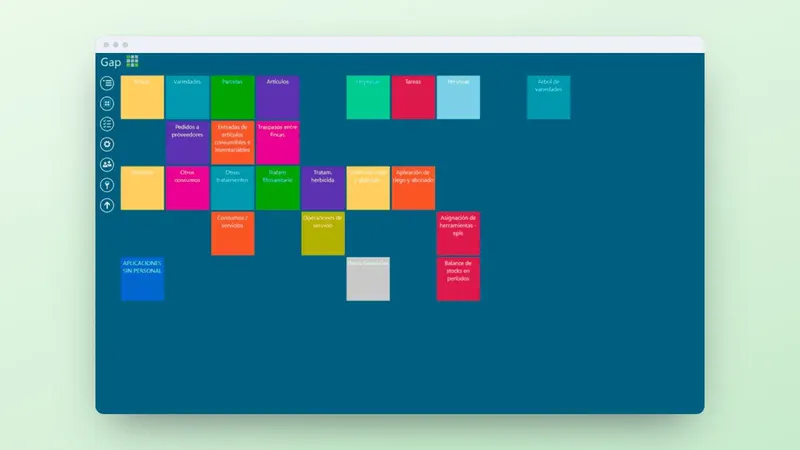
If your staff cost currently comes out as one overall figure rather than per plot, request information on how GAP allocates labour by task, variety and plot or call +34 959 54 07 12.
How to prepare the season's budget with two scenarios
1. Pull last season's hours by task and plot
Start from what you already have: last season's timesheets, assigned to each task (planting, pruning, harvesting, treatments) and to each plot. If you cannot get down to that level, at least split them by farm and variety. The post on the decision unit in farm management explains how to define that level properly so the numbers are useful.
2. Calculate with the current minimum wage and with the draft one
Do the sums twice: with the 2026 figure of 1,221 euros a month and with the 1,286 euros the Ministry of Labour proposes for 2027. That gives you a range rather than a single figure that may not materialise. If some categories on your farm are paid above the minimum under a collective agreement, the minimum wage rise affects them differently: check with your employment adviser which ones are close to the minimum before applying it to the whole workforce.
3. Convert it into cost per hectare and per kilo
Staff cost only tells you something when you set it beside the kilos from each plot. The cost items and the allocation of shared expenses are covered in the post on production cost per hectare, and depreciation in the one on machinery and fixed assets in farm operating costs. With the two scenarios, you will see which plots still give a margin and which are worth reviewing.
Bear in mind that GAP does not do payroll: it is an agricultural ERP that handles purchasing, sales, warehouses, costs and staff, and exports to your accounting. Your adviser still does the payroll; what GAP provides is knowing which plot and which task each cost went to.
What to do this week
- Gather last season's hours by task and plot, even if it is on a separate sheet.
- Calculate the staff cost of each plot with the 2026 minimum wage and with the 2027 proposal, and convert it into cost per kilo.
- Redo the sums when the royal decree appears in the BOE and replace the draft scenario with the final figure.
If you would like to see how that allocation would look with your farms and varieties, request information using the form on this page or call +34 959 54 07 12, Monday to Friday, 8:00 to 15:00 and 16:00 to 19:00.