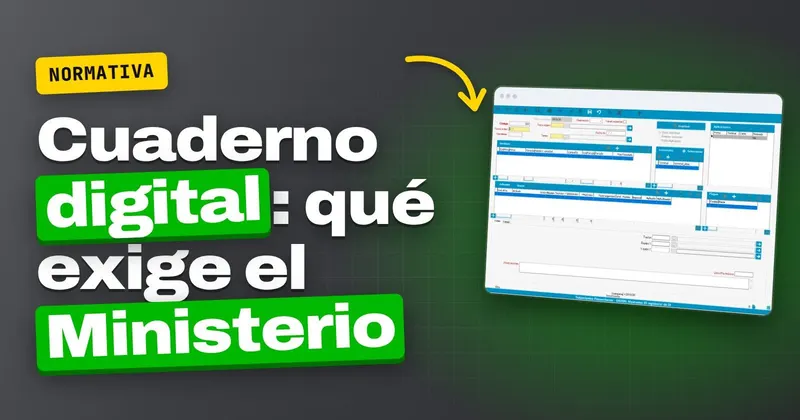

Recording plant protection treatments has been compulsory for years, but until now many farms could keep the record on paper. That is changing: Real Decreto 1311/2012 (the Spanish Royal Decree on the sustainable use of plant protection products), as amended by Real Decreto 1039/2025, allows this record to be kept on paper only until 31/12/2026. After that, treatments must be recorded in electronic format. Going digital does not fix the usual mistakes on its own; it makes them more visible, because the administration receives the data in a fixed format and can cross-check it. This article reviews the most frequent mistakes when recording treatments and how to avoid them.
What every treatment record must include
The minimum content is set out in annex III, part I, of Real Decreto 1311/2012. For each treatment, whether carried out by your own staff or by a service company, you must record:
| Data | Typical mistake |
|---|---|
| Date of treatment | Entering the date on which the work report is written up, not the day the treatment was applied. |
| Treated plot (identification number) | Writing "the one at the top" or the name of the farm instead of the specific plot. |
| Pest to be controlled | Leaving it blank or writing "preventive" without saying what against. |
| Applicator and, where relevant, adviser | Putting down the foreman even though someone else applied the treatment. |
| Crop, species and variety | Entering only the species when the farm has several varieties. |
| Treated area (ha) | Recording the area of the whole plot when only part of it was treated. |
| Product (trade name and registration no.) | Entering the active substance or a generic name with no registration number. |
| Machine or equipment used | Not identifying the equipment or not keeping its inspection up to date. |
| Kilos or litres of product used | Noting the label dose instead of the quantity actually used. |
| Assessment of effectiveness | Never filling it in. |
In addition, the general section of the logbook contains the farm's details, the plots with their SIGPAC reference (Spain's land parcel identification system) and, for each of your own application machines, the date of purchase or of the last inspection.
The mistakes that come up most often
1. Plots that do not match the official ones
This is the most common underlying problem. On the farm, plots have internal working names, have been merged or split over the years, and do not match the SIGPAC reference or what is held in the Registro Autonómico de Explotaciones Agrícolas (REA, the regional register of agricultural holdings). If a treatment is recorded against a plot the administration does not recognise, the digital submission will fail or be inconsistent. The first step is to have a table of equivalences between your working plots and the official plots.
2. Treated area calculated wrongly
When you treat one section, a few rows or a hotspot, the treated area is not that of the whole plot. If you record the entire plot, the per-hectare dose that comes out of the record makes no sense and consumption does not match the warehouse.
3. Product with no registration number or wrongly identified
"Copper", "sulphur" or whatever name the foreman uses is not enough. You need to record the trade name and the registration number, because that is how it is checked that the product is authorised for that crop and that pest. A one-digit error in the registration number is enough to make the entry invalid.
4. Theoretical quantity instead of the real one
Copying the dose from the prescription or the label is convenient, but the record asks for the kilos or litres actually used. If the tank was prepared for ten hectares and eight were treated, the difference must be reflected. Otherwise, warehouse stock and the record stop matching.
5. Recording weeks late
Treatments entered at the end of the month, or at the end of the season, end up with approximate dates and data written from memory. Article 16 of Real Decreto 1311/2012 provides that data must be entered in electronic format at least monthly. The practical approach is to record them the same day or the next day.
6. Forgetting treatments carried out by service companies
If a treatment is carried out by a contracted company, it also goes in your logbook. Keep the contract or the invoice for the service and record the data just as if you had done it yourself.
7. Not keeping the supporting documents
The same article 16 requires you to keep the records and the documentation that backs them up for at least three years: advisory documentation, equipment inspection certificates, service contracts, product purchase invoices and, where applicable, residue analyses.
Why paper hides mistakes and digital does not
In a notebook, a misspelt plot or an incomplete registration number goes unnoticed until an inspection arrives. In the digital logbook, each submission is validated against the administration's data: plots, authorised products and formats. That is a good thing, because mistakes surface sooner, but it means you need to have your base information in order. The change of format is a good moment to clean up the plot master data, review the products you hold in the warehouse and decide who records what.
A simple routine to avoid mistakes
- Before the season: check that your plots match those in the REA and that each application machine has its inspection up to date.
- Before each treatment: prepare the order with the plot, the product with its registration number, the dose and the pest to be controlled. Make sure the applicator takes it with them.
- When finished: the applicator records what actually happened: treated area, quantity used, equipment and any incident.
- The next day: someone reviews the work report, enters it in the record and deducts the product from stock.
- Every month: check that all the month's treatments are recorded and that consumption matches the warehouse.
- Afterwards: assess effectiveness and file invoices, certificates and contracts.
Monitoring pests in the field and deciding whether to treat is a different job, with its own tools; for that, Infonet has Agrimaps. Here we are talking about what happens afterwards: keeping a proper record of what was applied.
How GAP solves it
In GAP, treatment orders are prepared by farm, variety and plot, with their items, doses and active substances, and consumption is deducted from the stock of each warehouse. Field work reports can be entered with a photo, an audio message or a text message: they remain pending confirmation, like those from the field tablet.
For the digital logbook (CUE), GAP imports your farms and plots from the REA exactly as the administration holds them, sends the season's treatments to your autonomous community's system in the format it requires, and checks the status of each submission to alert you if anything needs correcting. If you are a cooperative or an advisory firm, you can submit your growers' logbooks as an authorised entity.