If you still jot treatments down in the foreman's notebook and copy them into the field logbook at the end of the season, you will want to know what Spain's Ministry of Agriculture requires and from when. The short answer: the digital field logbook is voluntary for the duration of the 2023-2027 CAP (Common Agricultural Policy), but the plant protection treatment record will have to be kept in electronic format from 01/01/2027. Below you have each rule with its reference and date, who it affects, a table of deadlines and what to prepare before 31/12/2026.
What the Ministry of Agriculture's digital field logbook is
The Ministry regulates the digital farm logbook (CUE) within the Farm Information System (SIEX), which is governed by Royal Decree 1054/2022 (RD 1054/2022). The digital logbook is one of the two ways of keeping the farm logbook; the other, paper, is still valid for almost everything.
In practice, data is not sent to a single Ministry portal. Each autonomous community has its own official service, and the data reaches SIEX through it. The starting point is the farms and plots registered in the REA (Spain's Register of Agricultural Holdings): if you want to review what it holds and what to check before reporting anything, you will find it in what the REA is in agriculture and how it relates to the logbook.
Is it compulsory to keep the logbook digitally?
Not today. Royal Decree 34/2025 (RD 34/2025, BOE-A-2025-998), which amended RD 1054/2022, made the digital logbook voluntary for the duration of the 2023-2027 CAP, unless a sector-specific rule requires the electronic format. The Ministry explained this in its press release on the voluntary nature of the digital logbook.
That exception is the one that matters this winter, because there is already a sector-specific rule that requires the electronic format: the one on plant protection products.
Plant protection treatments move to electronic format on 01/01/2027
Royal Decree 1039/2025 (BOE of 20/11/2025, BOE-A-2025-23421; the BOE is Spain's Official State Gazette) amended, in its first final provision, Article 16.1 of Royal Decree 1311/2012 (RD 1311/2012, on the sustainable use of plant protection products). The plant protection treatment record is accepted on paper until 31/12/2026, and from 01/01/2027 it must be kept in electronic, machine-readable format. It affects professional users in the agricultural sector and is based on Implementing Regulations (EU) 2023/564 and 2025/2203.
31/12/2026 is the last day on which the plant protection treatment record is accepted on paper. From 01/01/2027 it must be kept in electronic format, even if the rest of the logbook stays on paper.
If you want the detail of what data each entry must contain under RD 1311/2012, it is in our logbook guide. And to avoid repeating the most common mistakes when making entries, review the errors when recording treatments in the digital logbook.
In GAP, the treatment starts with the technical order: farm, target plots, products with their dose and pre-harvest interval, pests, tractor and equipment. What is applied is recorded by plot and active substance, and deducted from warehouse stock.
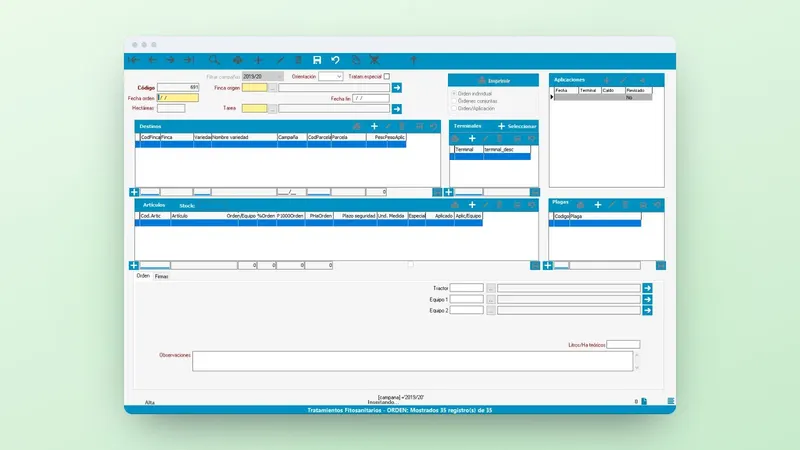
If your treatments currently go out on paper to the applicator, GAP records them from the order and reports them to the digital logbook (CUE) through the official service of your autonomous community, either as a producer or as an authorised entity, checking that the administration accepts them: request a demo with your plots.
Each fertiliser application must be logged within one month at most
Since 01/01/2026, each application of nutrients or organic matter must be entered in the logbook's "Fertilisation" section within one month at most. This is set out in Royal Decree 1051/2022 (RD 1051/2022, on sustainable nutrition of agricultural soils), as amended by Royal Decree 934/2025 (RD 934/2025, BOE-A-2025-21211); the Ministry summarised it in its press release of 21/10/2025. The format here is free: paper or digital.
Farms of up to 5 ha with no more than 1 ha of irrigated land, and those with only unfertilised pasture, are exempt. In addition, the fertilisation plan is compulsory from 01/09/2026. You will find all the details in what sustainable nutrition requires in the fertilisation record.
Which record goes in which format, and from when
| Record | Format | From | Rule |
|---|---|---|---|
| Full farm logbook | Paper or digital (voluntary) | For the duration of the 2023-2027 CAP | RD 1054/2022, amended by RD 34/2025 |
| Plant protection treatments | Paper accepted until 31/12/2026 | Electronic compulsory from 01/01/2027 | RD 1311/2012, Art. 16.1, amended by RD 1039/2025 |
| Fertilisation | Paper or digital, within one month at most | 01/01/2026 | RD 1051/2022, amended by RD 934/2025 |
| Fertilisation plan | Paper or digital | 01/09/2026 | RD 1051/2022, amended by RD 934/2025 |
Who is affected and who is not
- Professional users of plant protection products in the agricultural sector: the treatment record in electronic format from 01/01/2027, whatever the size of the farm.
- Farms that fertilise: logging each application in the logbook is already in force, apart from the exceptions for size and pasture.
- All farms: they can continue with the paper logbook for all other entries for the duration of the 2023-2027 CAP.
Beware of what circulates online: a supposed regional obligation to keep a digital logbook based on farm size appears only on a commercial blog and has no rule behind it. For anything at national level, what counts is what is published in the BOE.
What happens if treatments are still on paper on 01/01/2027
Under Article 16.1 of RD 1311/2012 as currently worded, paper records will no longer be accepted for treatments from that date. A treatment noted only in the notebook would not meet the format the rule requires, even if the data is complete.
The practical approach is not to reach January with the season half done: if December's treatments already go in digitally, the turn of the year won't catch you redoing entries. And if you also track costs, every treatment recorded by plot also tells you how much it cost, as explained in production costs.
What to do before 31/12/2026
- Check in the REA that your farms and plots are correct, because they are the basis of the digital logbook.
- Decide who records each treatment and when: the technician when issuing the order, the applicator when finished, or the office when the work report arrives.
- Choose the tool and test it with December's treatments, so that you reach 01/01/2027 with the treatment record already in electronic format.
If you want to see how treatment orders, active substances by plot and the digital field logbook are managed on a single platform, request a GAP demo or call +34 959 54 07 12.